
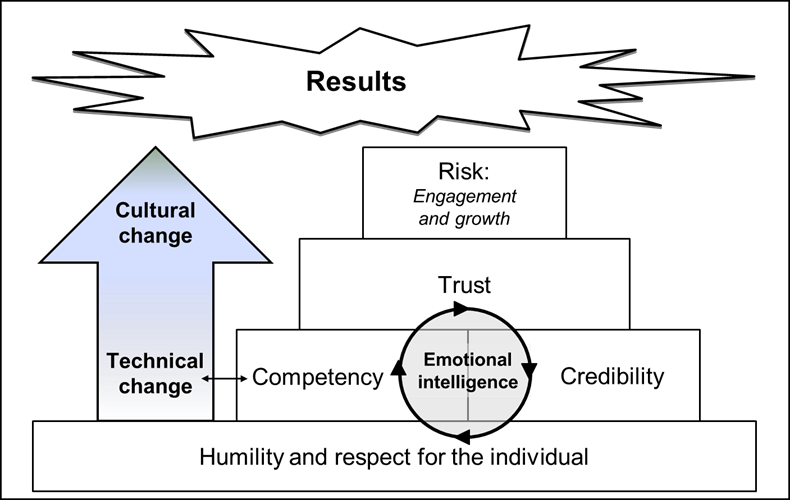
Figure. Transformational role of emotional intelligence (Kaizen Event Fieldbook, Hamel)
The title of this post may be a head-scratcher but please hang in there, the message is important.
We live and work within a socio-technical ecosystem. The pure technical side affords no behavioral choice. “Machines,” like CNC machining centers, MRIs, pick-and-place robots, and the code driving a whole host of computer applications are governed by mathematics and the physical sciences, such as physics and chemistry. Especially when this stuff is insulated from human intervention, problem solving a technical issue is well…technical.
Then there is the social side of the socio-technical. The late American organizational theorist, Russell Ackoff, believed that “social systems have purposeful systems as their principal parts, and purposeful behavior consists of choices of ends and means.” That makes sense.
Enter now emotions, like the ones that brew inside folks whenever there is change or even a whiff of change. As continuous improvement practitioners, we witness this reality firsthand. We necessarily traffic in change, hopefully good change (kaizen).
Many folks rightly note that “change is hard.” The degree of difficulty is sometimes determined solely by the technical challenge, often the social disruption, and, in my humble opinion, predominantly the combination of social AND technical strain.
An executive once exclaimed during a strategy deployment workshop that, “A good breakthrough objective should make your stomach hurt.” The stomach pain is likely induced because the relevant performance or capability gap appears near insurmountable, perhaps for several compelling reasons…at least at the very moment. Not dissimilarly, the pain may well be (also) caused by deep concerns about personal career risk and anticipated futile efforts.
Improperly managed, emotions can unfavorably impact cognition (aka we can lose our reason or not be in our right mind) and drive less than effective behaviors. Unchecked emotions can freeze folks into inaction and disengagement, prompt them to take seemingly illogical actions and/or actively resist and even sabotage the change.
While change management models or processes, such as Kotter’s and ADKAR, can be super-helpful, they don’t work unless we effectively address emotions. Good change models are designed, at least implicitly, to deal with ineffective emotions and evince and harness good emotions. Realistically, though, we’re not going to go full change model in every situation. But we should always apply emotional intelligence (EI) even if it is running in our (intuitive) “background.” Because we swim in a socio-technical universe, every leader and coach needs social intelligence.
EI was pioneered by Daniel Goldman, Peter Salovey, and John Mayer, among others. It is mainstream enough that it is even defined within Merriam-Webster: “the ability to recognize, understand, and deal skillfully with one's own emotions and the emotions of others.”
Emotion-Based Problem Solving
OK, so where is the problem-solving part? For that we can refer to the Emotion Roadmap(TM), which was introduced to me by Chuck Wolfe, an EI expert, coach, friend, and colleague, and who collaborated with me in a chapter on transformation leadership in my Kaizen Event Fieldbook. The roadmap is emotion-based planning and problem solving.
It is pure PDCA.
The table below identifies the four abilities and inherent sequence within the roadmap. The first three abilities correspond to “plan” within PDCA. While the fourth ability finalizes “plan” and then proceeds on to “do-check-act.”
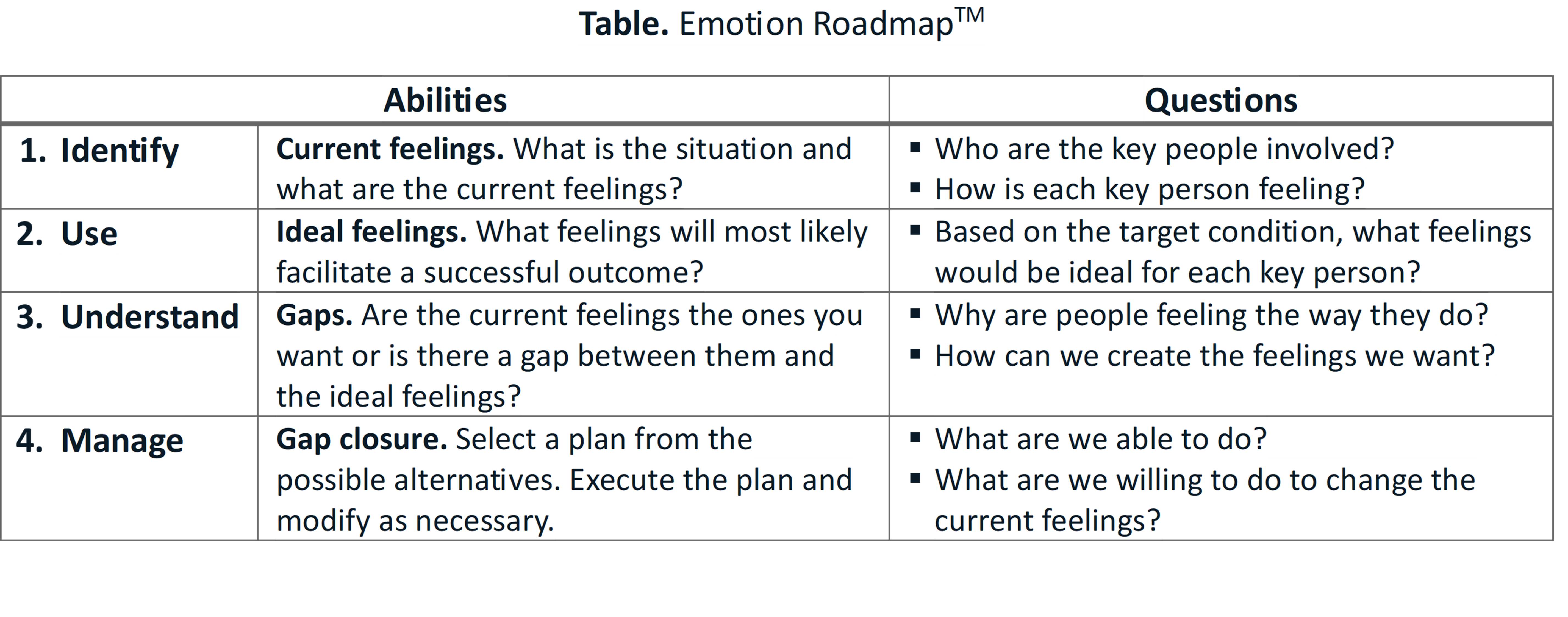
Source: Kaizen Event Fieldbook, page 58 (credit Chuck Wolfe)
Identifying current feelings is akin to the lean practitioner's "grasping the situation" and requires an awareness enabled by emotional intelligence. As we consider ideal feelings, we may equate this to the lean notion of target condition. Here we might generically (and safely) assume our target condition to encompass the three Cs of lean leadership, whether the scope is an enterprise transformation, a project, kaizen event, personal competency and behavior development, and so forth…or all the above. We desire our stakeholders to feel:
- Challenge(d). Leaders and coaches should desire folks to feel, understand, and embrace the challenge for good change. Think of challenge as the gap between current and target condition. This extends to measurable results, rigor, and principle-driven behavior. It is, in a way, a microcosm of the hero’s journey, not necessarily Frodo’s in the Lord of the Rings (!), but nevertheless something worthy, noble and appropriately uncomfortable.
- Courage(ous). People need a measure of confidence or safety to undertake the challenge, to push out into the deep. Courage is founded in trust. Rational people will not take risk without trust. As reflected in the figure above, trust is facilitated by consistently demonstrated leader competence and credibility. In other words, leaders know what they are doing and why they are doing it and do what they say. This latter characteristic is founded in humility and respect for the individual.
- Creativity(ive). Challenge provides the directional pull and impetus for change, while courage provides the safe freedom necessary for full engagement, trystorming, and learning. Lean provides the snow fences in terms of principles, systems, and tools, within which teams and individuals operate and use their inherent knowledge and creativity to perpetually innovate and improve (see my post, “The Growth Mindset is a Lean Mindset”). Humble leaders humbly recognize and enable the democratized power of continuous improvement.
Certainly, understanding current and (ideal or) target feelings will help us to characterize the gaps (aka the problem). This logically leads us to formulating a gap closure plan(s), which, like any good problem solving rigor, requires insight into causality, but also emotional consequences. Ultimately, we need to pick the best plan and implement it.
We can explore a host of examples, but the point here is that transformation necessarily engages the full person, emotions and all. We operate in a socio-technical world. Lead with emotional intelligence.
